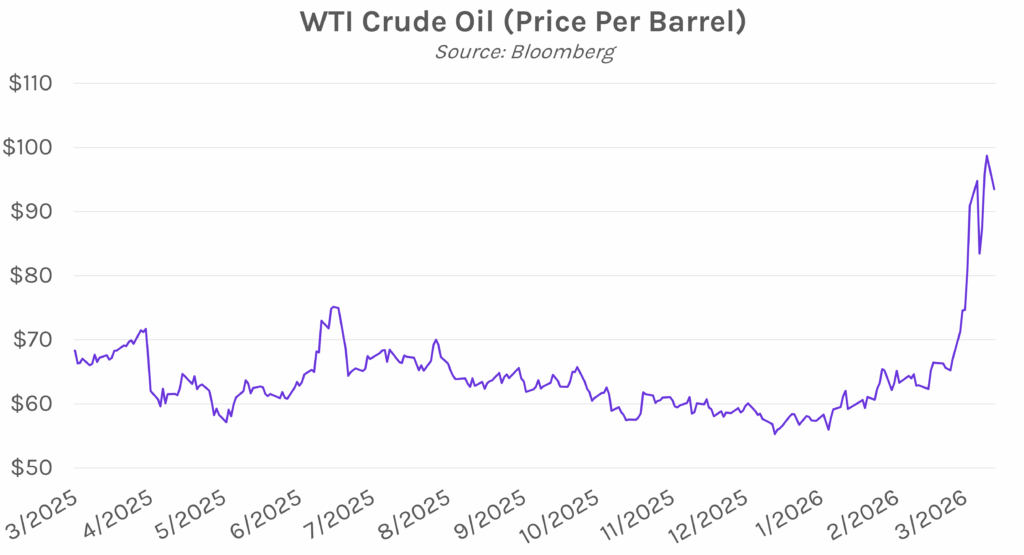
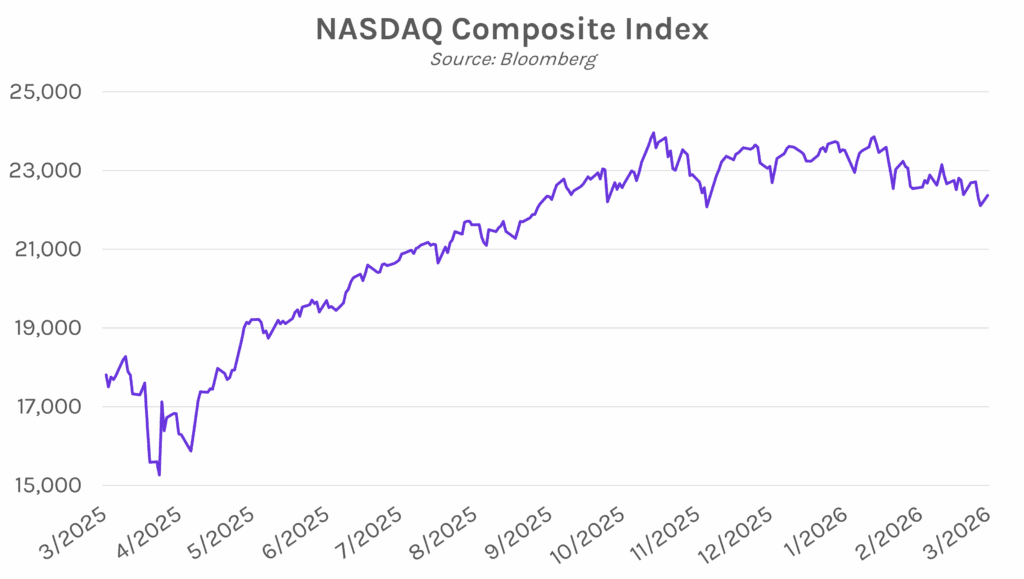
Yields fall on easing inflation concerns. Treasury yields declined alongside sliding oil prices today on hopes that the Strait of Hormuz will reopen to tankers and news that more emergency oil stockpiles could be released. Yields closed 4-6 bps lower across the curve, with the 2-year yield at 3.67% and the 10-year yield at 4.22%. WTI closed at $93.50 per barrel after surpassing the $100 price level last week. Meanwhile, equities rose today, with the S&P 500 and NASDAQ closing 1.01% and 1.22% higher, respectively.
Trump urges China to assist in unblocking the Strait of Hormuz. US President Donald Trump threatened to delay his visit with Chinese leader Xi Jinping if China does not help unblock the Strait of Hormuz. Trump emphasized China’s own dependence on Middle Eastern oil, saying “It’s only appropriate that people who are beneficiaries of the strait will help to make sure that nothing happens there.” Trump is currently planning on meeting with Xi in China at the end of this month, and US Treasury Secretary Scott Bessent later said that any delay would be due to logistics. China has not directly responded to Trump’s request, though state-run media said that this request is to share “the risk of a war Washington started and can’t finish.”
IEA says it could release additional oil reserves. The International Energy Agency has said it could release additional barrels of oil, beyond the record 450 million already pledged. The emergency drawdown currently underway will only reduce the IEA’s reserves by 20%, and IEA Executive Director Fatih Birol said there are “over 1.4 billion barrels remaining, which means we can do more later, as and if needed.” The potential for further emergency oil releases comes as the closing of the Strait of Hormuz has increased oil prices by over 40% in the past two weeks and has been characterized as the largest-ever disruption to global oil flows. Under the IEA’s coordinated response plan, countries in Europe have collectively committed over 100 million barrels, countries in Asia to the same, and countries in the Americas to over 170 million barrels, in addition to more than 20 million barrels expected from increased production.