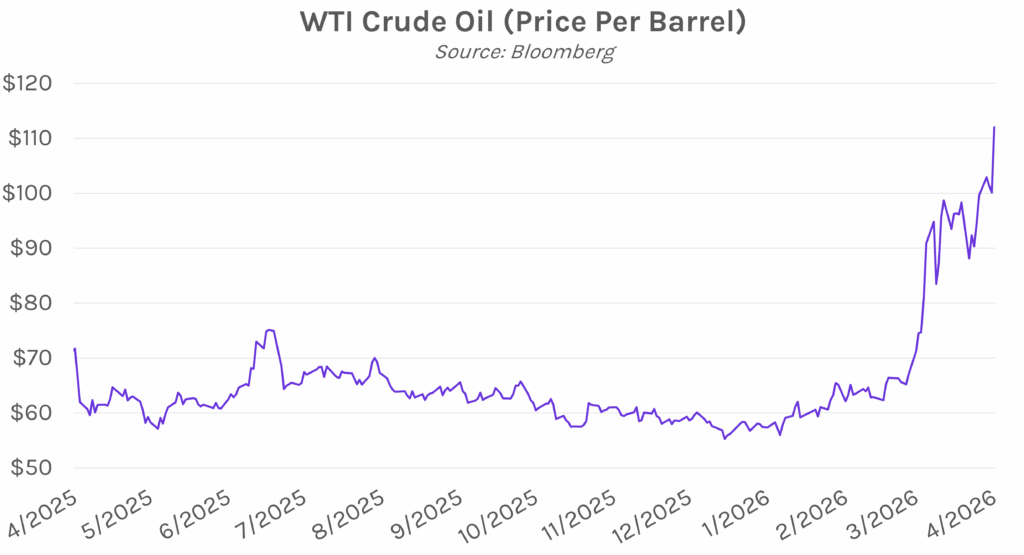
Yields nearly unchanged as markets digest war developments. Treasury yields climbed ~6 bps to intraday highs after Trump’s speech last night, where the president asserted that the US would continue its attacks on Iran, providing little optimism about an imminent ceasefire. The move gradually reversed course as yields closed nearly flat across the curve, with the 2-year yield at 3.80% and the 10-year yield 1bp lower at 4.30%. Meanwhile, equities reversed an earlier sell-off on news that Iran is working on a plan to reopen the Strait of Hormuz, with the S&P 500 closing 0.11% higher. Oil prices soared yet again, with Brent trading around $109 per barrel and WTI around $112 per barrel, intraday gains of ~8% and ~12%, respectively.
Iran drafts plan to monitor Strait of Hormuz, while Trump threatens escalation. According to state-run reports, Iranian Deputy Foreign Minister Kazem Gharibabadi said that they are working with Oman to create a protocol to monitor vessel traffic in the Strait of Hormuz. Gharibabadi said, “these requirements do not constitute restrictions, but are intended to facilitate and ensure safe passage and provide better services to ships transiting this route.” He noted that traffic supervision should take place even during peacetime. Meanwhile, President Donald Trump added to his speech from last night, threatening Iranian infrastructure today in an attempt to push negotiations. Trump posted on social media, “IT IS TIME FOR IRAN TO MAKE A DEAL BEFORE IT IS TOO LATE, AND THERE IS NOTHING LEFT OF WHAT STILL COULD BECOME A GREAT COUNTRY!”
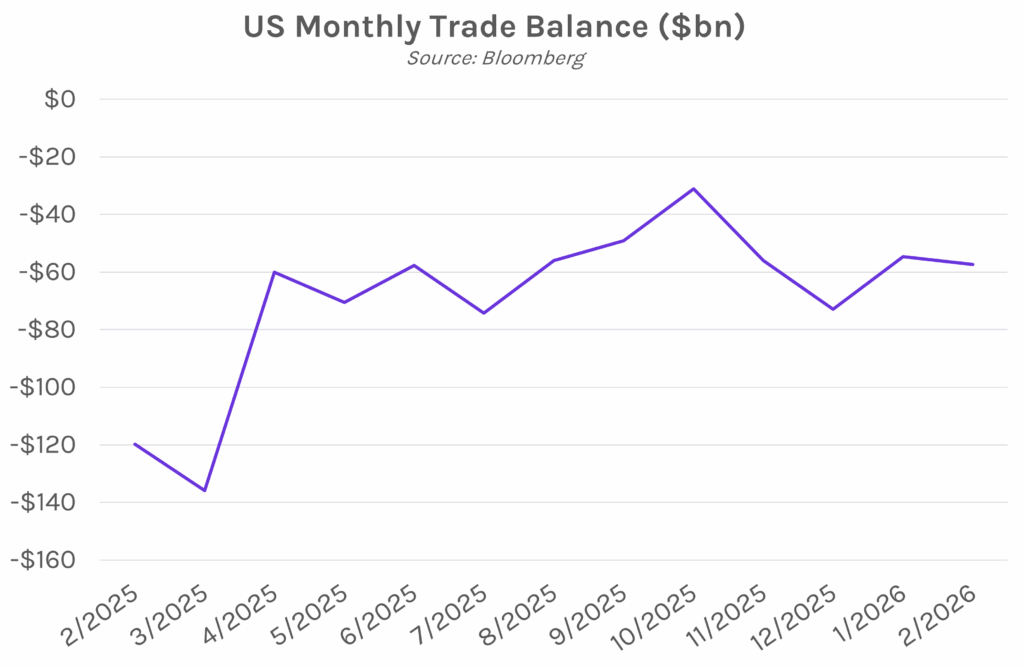
February trade deficit increases less than expected. The US trade deficit increased 4.9% to $57.3 billion in February, up from $54.5 billion in the prior month but below forecasts of $60.6 billion. Exports climbed 4.2% to a record $314.8 billion, driven by gold and natural gas, while imports rose 4.3%, led by computers, semiconductors, and automobiles. Goods imports neared a one-year high, increasing 5% to $291.5 billion. US tariffs are now at their lowest level since April of last year after the Supreme Court struck down many of President Trump’s levies. However, experts believe global trade volumes could decline due to shipping disruptions stemming from the war in Iran.