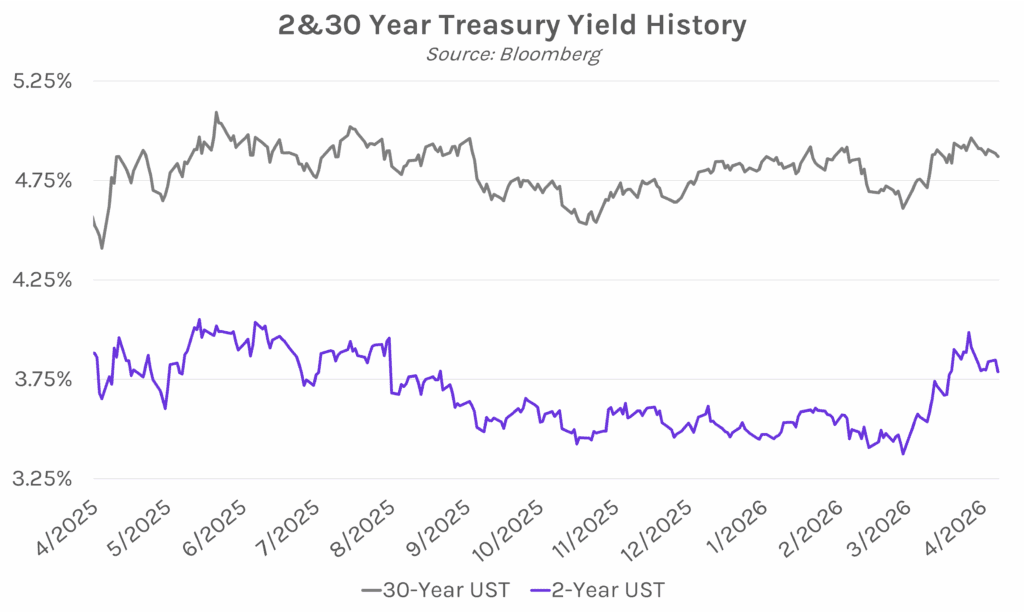
Yields fall on renewed ceasefire hopes. Treasury yields rose and fluctuated in a 4-6 bp range for most of the session after President Trump ramped up his threats on Iran ahead of the deadline he set to reopen the Strait of Hormuz. However, markets shifted risk-on in the late afternoon as reports broke that Pakistan is seeing progress in its push for a deadline extension. The 2-year yield closed 6 bps lower at 3.79%, while the 30-year yield closed 2 bps lower at 4.87%. The renewed ceasefire optimism helped equities reverse an earlier sell-off, with the S&P 500 and NASDAQ closing 0.08% and 0.10% higher, respectively.
Two-week ceasefire reached after Trump threatens to wipe out a “whole civilization.” President Trump posted on Truth Social today that a “whole civilization will die tonight” if Iran does not reopen the Strait of Hormuz by 8 p.m. EST this evening. In the hours following the threat, conflicting messaging emerged around the progress of diplomatic negotiations. It was initially reported that Iran withdrew from ceasefire talks in response to President Trump’s post, but an Israeli official later said that discussions were still progressing. Pakistan, acting as a mediator, proposed a two-week ceasefire and deadline extension for Iran to reopen the critical shipping lane, stating the period would “allow diplomacy to run its course.” According to reports and President Trump’s social media, the US and Iran have accepted the deal.
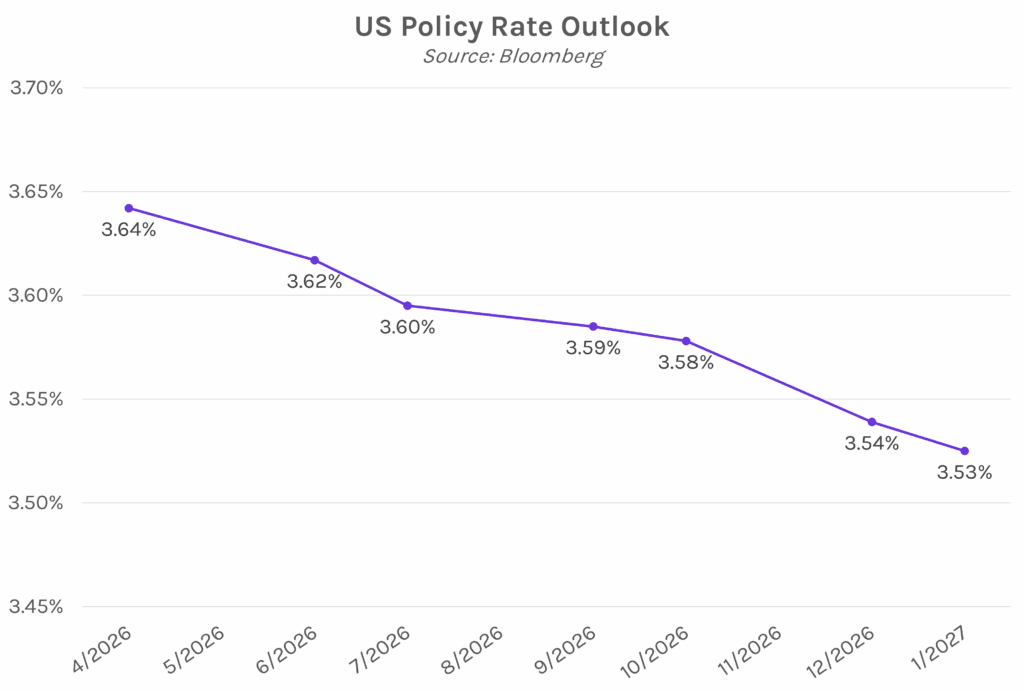
Fed’s Williams sees underlying price pressures remaining steady. New York Fed President John Williams said, “the story hasn’t changed very much” for underlying price pressures on inflation, though the Iran War has led him to decrease his forecast for economic growth this year and increase his headline inflation expectation. Consequentially, Williams is comfortable leaving policy rates unchanged in the near term, explaining that “monetary policy is exactly where it needs to be, and then we can respond if the situation changes.” Last week’s surprisingly strong March labor data adds to Williams’ confidence that policy rates are well positioned, as it is a sign that the job market is “much more stable now, definitely not a labor market that is weakening.”