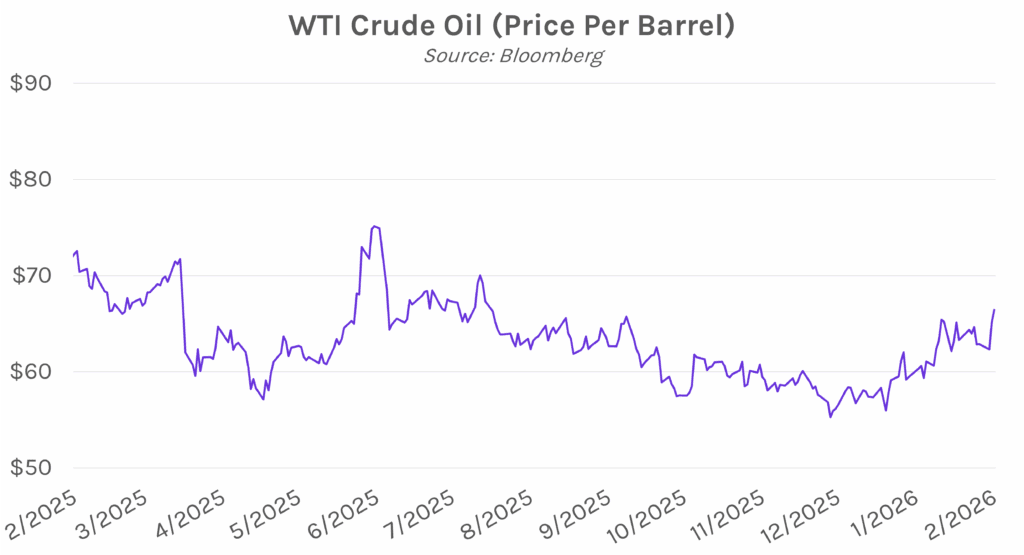
Yields close largely unchanged on mixed data. Treasury yields climbed in the aftermath of slightly better-than-expected initial jobless claims, though price action reversed course over the remainder of the session, supported by weak pending home sales data. The 2-year yield closed nearly flat at 3.46%, while the 10-year yield closed 2 bps lower at 4.07%. Meanwhile, equities declined today on escalating tension between US and Iran, where the US has been deploying troops for a potential attack if a nuclear agreement can’t be reached. The S&P 500 and NASDAQ closed 0.28% and 0.31% lower. Meanwhile, oil prices surged again today on the geopolitical concerns, with WTI crude hitting its highest levels since August at nearly $67 per barrel.
Miran pulls back 2026 rate cuts forecasts. Fed Governor Stephen Miran said today that he pulled back on his preference for aggressive rate cuts following recent economic data. Miran shared that recent jobs data showed the labor market holding up better than he anticipated, while inflation remains sticky. With that in mind, Miran said, “…those two things combined would make me undo what I did in December.” In the Fed’s December Dot Plot, Miran projected policy rates dipping below 2.25% by the end of 2026. His new position forecasts policy rates falling below 2.75% by year-end, which is still aggressive compared to other Fed officials, with the median projection seeing ~25 bps of rate cuts this year.
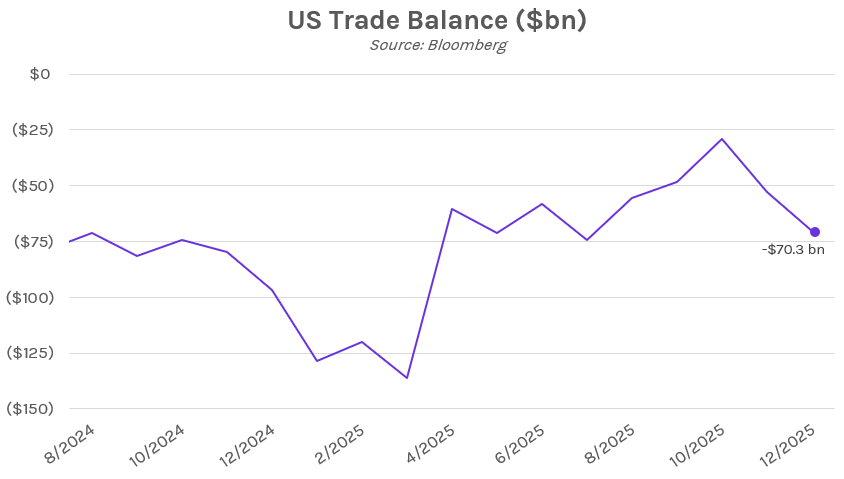
US trade deficit with China falls to 21-year low. The total US trade deficit for the month of December came in at $70.3 billion, higher than estimates of $55.5 billion and November’s downwardly revised $53.0 billion deficit. The rise comes as imports increased 3.6% and exports declined 1.7% compared to the prior month. Notably, on an annual basis, the US trade deficit with China fell to $202 billion in 2025, the lowest in over two decades. However, in the same period, the US trade deficit with Mexico and Vietnam widened to record levels of $196.9 and $178.2 billion, respectively, as President Trump’s tariffs reordered global trade. The US trade deficit with Taiwan also surged, nearly doubling compared to 2024 as semiconductor and electronics imports spiked amid strong AI-related demand. Bloomberg estimates the effective tariff rate across US goods imports to be 13.6%, the highest level since the 1940s prior to last year.