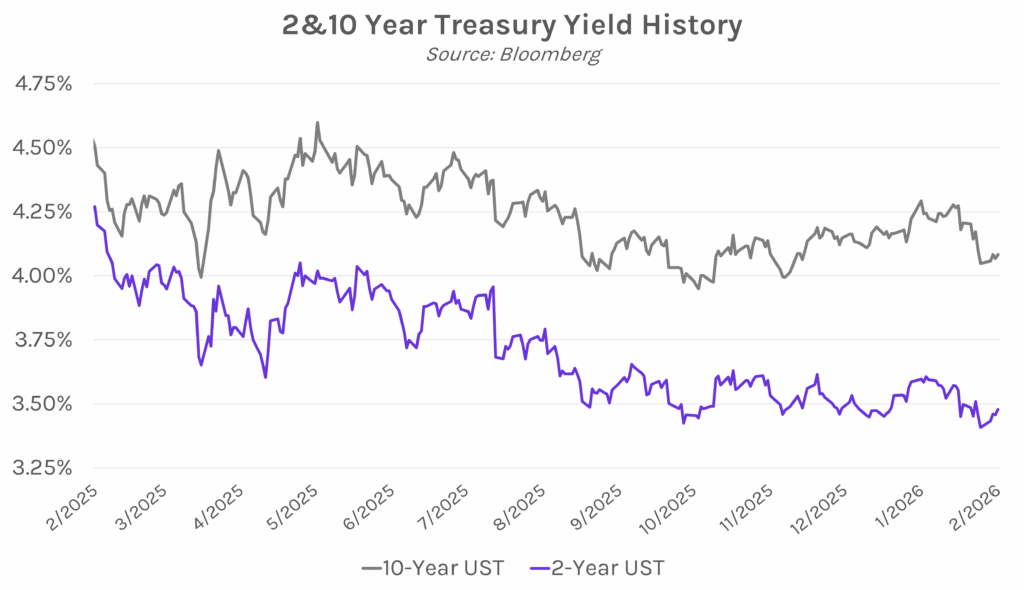
Yields close higher as tariff uncertainty looms. Treasury yields rose slightly in the aftermath of hotter-than-expected PCE data and a GDP miss, reflecting a focus on sticky inflation. Shortly after, yields whipsawed when news broke that the Supreme Court struck down Trump’s global tariffs, initially spiking 2-3 bps before dropping and then rising again. The choppiness can be attributed to uncertainty around the government budget going forward, despite Trump’s pledge of a 10% global levy as a replacement. Yields closed 1-3 bps higher across the curve, with the 2-year yield at 3.48% (up 7 bps on the week) and the 10-year yield at 4.08% (up 3 bps on the week). Equities ultimately climbed on the tariff news, with the S&P 500 and NASDAQ closing 0.69% and 0.90% higher, respectively.
Supreme Court strikes down Trump’s tariffs. In a 6-3 decision today, the Supreme Court ruled that President Trump does not have authority to impose tariffs under the International Emergency Economic Powers Act (IEEPA). While other presidents have imposed sanctions under the act, none have used it to levy taxes, a constitutional power afforded to Congress. In the majority opinion, Chief Justice Roberts wrote, “The Framers did not vest any part of the taxing power in the Executive Branch.” Justices Alito, Thomas, and Kavanaugh dissented, with Kavanaugh writing, “The tariffs…may or may not be wise policy. But as a matter of text, history, and precedent, they are clearly lawful.” It’s uncertain whether the government will have to refund any tariff revenue, or how such a process would occur. The Treasury had collected an estimated $133 billion in IEEPA tariff revenue as of December. Today’s ruling does not stop the President from enacting tariffs under different laws, and Trump has already pledged a new 10% global tariff under the Trade Act of 1974.
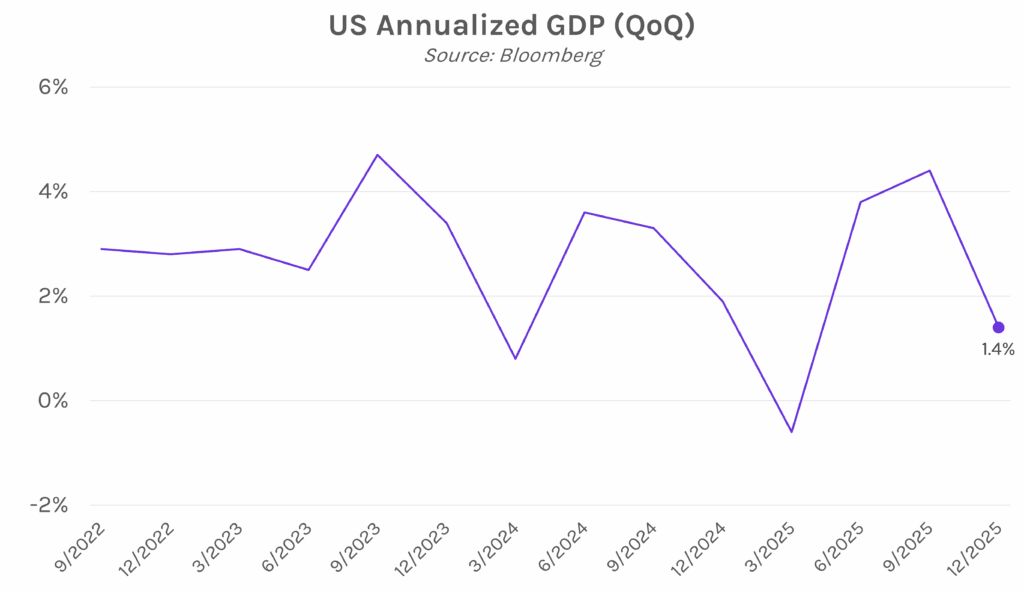
Fourth quarter GDP misses expectations on government shutdown. Inflation-adjusted US GDP data for the fourth quarter of 2025 increased at an annualized 1.4% versus the 2.8% expected and 4.4% in the prior quarter. The weak print comes as the US government shutdown lasted nearly half of the quarter. The Bureau of Economic Analysis estimates that the decrease in federal services caused a 1% reduction from GDP, though the full impact stemming from the shutdown is difficult to estimate. Overall, GDP expanded by 2.2% last year, relatively strong considering that GDP shrunk in the first quarter as imports surged due to tariff announcements. Resilient consumer spending and artificial intelligence investments helped support GDP growth. Olu Sonola, head US economist at Fitch Ratings said, “Zooming out to 2025, growth clearly cooled, but given the policy whiplash, coming in above 2% looks better than it had any right to.”