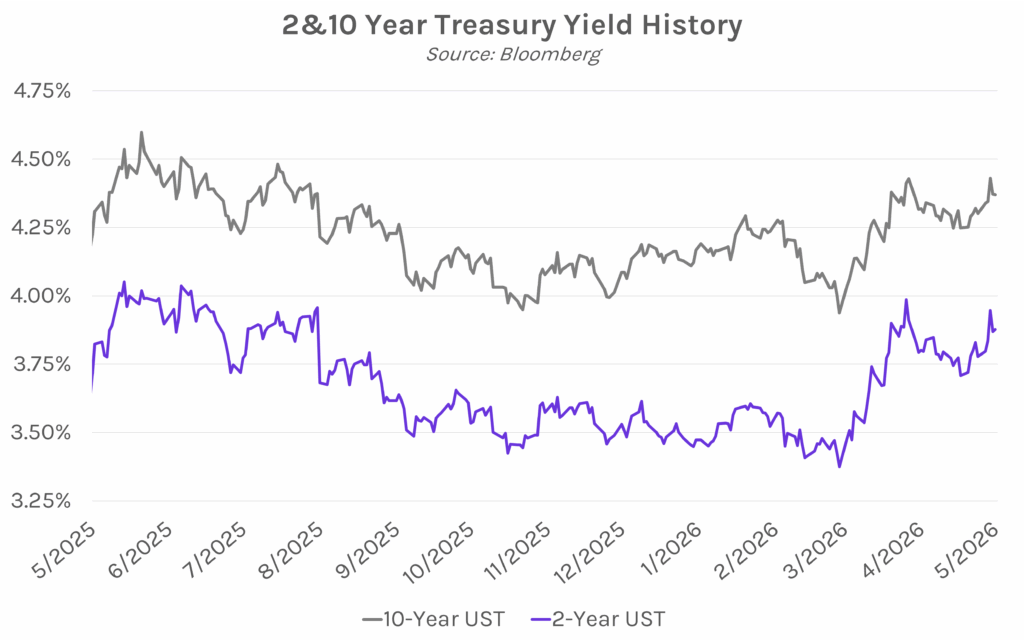
Yields close nearly flat as markets digest news on the Iran war. Treasury yields dropped this morning following reports that Iran responded to the US on a peace proposal, though the move reversed due to a lack of details. Shortly after, yields fell ~6 bps from intraday highs as Iranian Foreign Minister Araghchi indicated that Iran was ready to resume diplomatic efforts, if the US changes its approach. The 2-year yield closed 1bp higher at 3.88% (up 10 bps on the week) and the 10-year yield closed nearly unchanged at 4.37% (up 7 bps on the week). Meanwhile, equities climbed as Apple Inc. posted a strong earnings outlook, with the S&P 500 and NASDAQ closing 0.29% and 0.89% higher, respectively.
Trump dissatisfied as Iran presents new peace proposal. According to Iranian state television, Tehran delivered a new peace proposal to the White House via Pakistan. While it is unclear whether Trump was referring to this new proposal, he told reporters today that Iran “want[s] to make a deal but I’m not satisfied with it,” adding that he is “not happy.” Iranian state media did not indicate whether the proposal addressed sensitive issues such as Iran’s nuclear program or the Strait of Hormuz. Other reports suggest the proposal includes conditions for reopening the strait while requiring the US to end its naval blockade and stop attacks. These developments come a day after Mojtaba Khamenei, Iran’s new supreme leader, gave a rare public statement vowing to preserve nuclear technology and maintain control over the Strait of Hormuz.
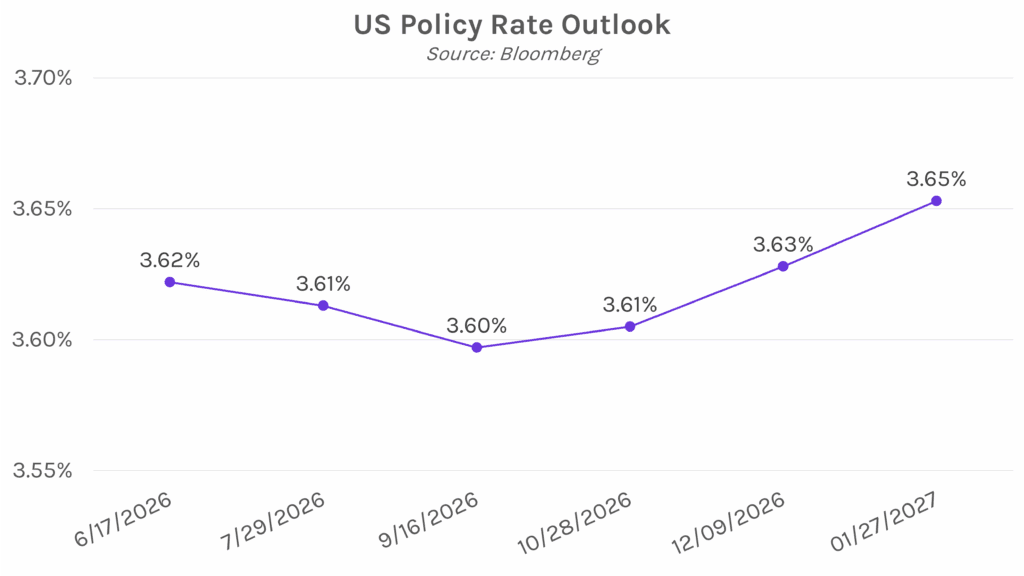
Fed’s officials explain decision to dissent. At Wednesday’s FOMC meeting, Fed officials Neel Kashkari, Beth Hammack, and Lorie Logan agreed with the decision to hold rates steady, but opposed language in the statement that indicated potential rate cuts in the future. In a statement today, Kashkari said, “I believe the FOMC should offer a policy outlook that signals that the next rate change could be either a cut or a hike, depending on how the economy evolves.” Hammack echoed this, noting how a “clear easing bias” is “no longer appropriate” given the uncertainty stemming from the war in Iran. Similarly, Logan remains focused on “prolonged or repeated supply disruptions that could create inflationary pressures,” saying, “It could plausibly be appropriate for the FOMC’s next rate change to be either an increase or a cut.” Futures markets currently have neither a rate cut nor hike fully priced in over the next year.