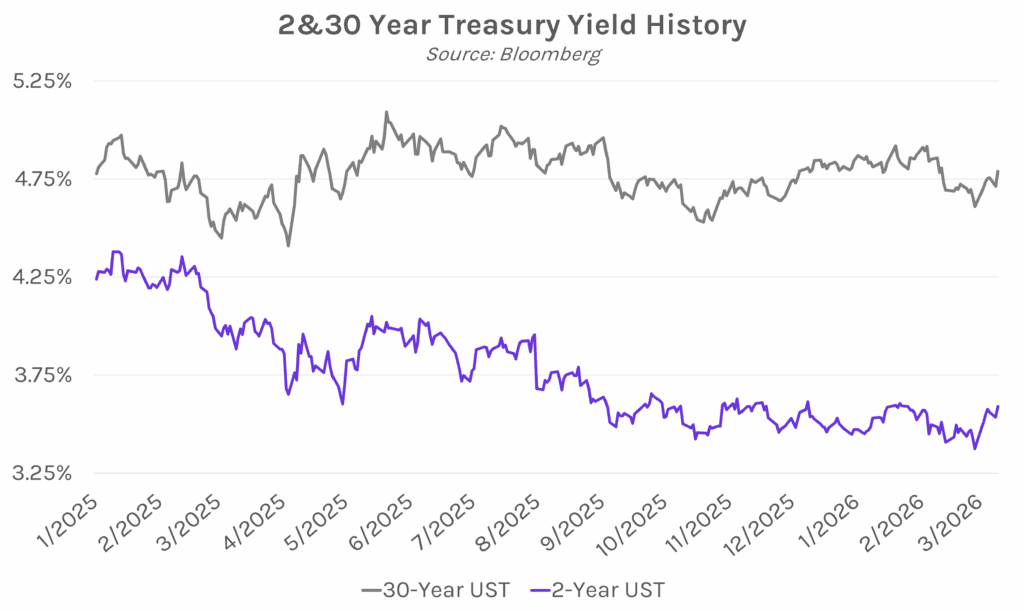
Yields rise on mixed war signals. Treasury yields saw a volatile session today as markets digested mixed messaging on oil supplies from the war in Iran. Yields declined this morning, before climbing over the remainder of the session as crude futures rose on White House clarification that no oil tankers have been escorted through the Strait of Hormuz, disputing an earlier communication. The 2-year yield closed 5 bps higher at 3.59%, while the 30-year yield closed 8 bps higher at 4.79%. Meanwhile, equities were mixed with the S&P 500 closing 0.21% lower and the NASDAQ up 0.01%. Brent crude futures are currently trading around the $91 price level, after closing at $98.96 yesterday.
Energy volatility persists on conflicting White House messaging. Oil prices jumped around yet again today on conflicting messages from the Trump Administration. Energy Secretary Chris Wright posted on social media that the US Navy had successfully escorted an oil tanker through the Strait of Hormuz, causing oil prices to plummet. WTI crude, the US benchmark, fell nearly 20% on the news, below $77 a barrel. However, Wright’s post was subsequently deleted and White House Press Secretary Karoline Leavitt confirmed that no such military action occurred. Leavitt did say that the US military was “drawing up additional options” to counter Iran’s attempts to constrain shipping through the Strait of Hormuz. Following the Trump Administration’s clarification, oil prices reversed, with WTI ending the day above $86 a barrel.
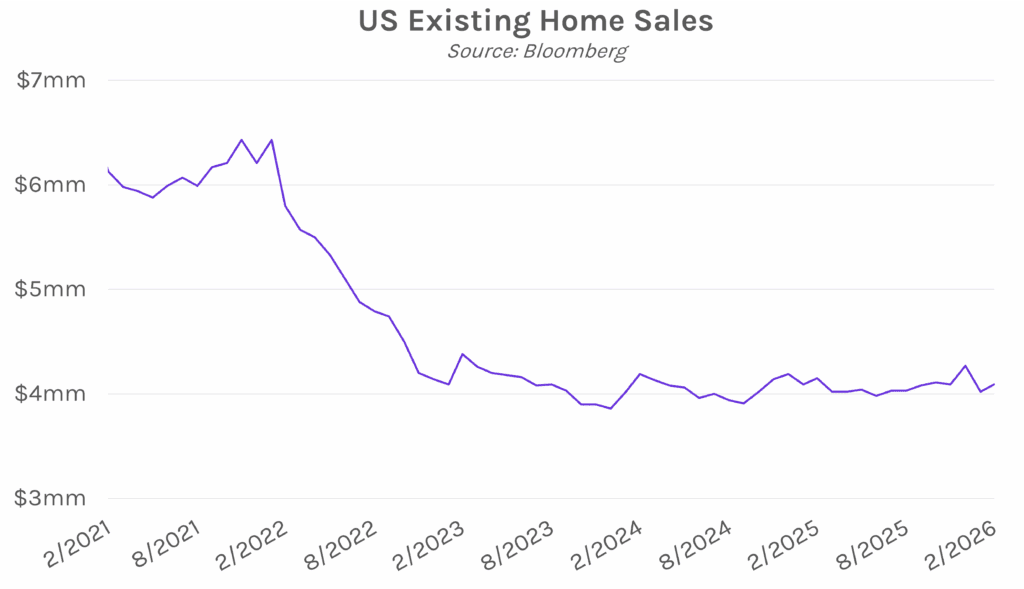
Existing home sales increase on affordability. February home sales increased to 4.09 million annualized against expectations of 3.88 million and January’s (revised) 4.02 million. The unexpected improvement came as mortgage rates have declined and the National Association of Realtors’ monthly affordability gauge posted its most favorable reading since 2022. The median selling price did rise 0.3% from a year prior, though this was one of the smallest advances since the pandemic. NAR Chief Economist Lawrence Yun said, “Housing affordability is improving, and consumers are responding. Still, there is a long way to go to return to pre-pandemic levels of transaction activity.”