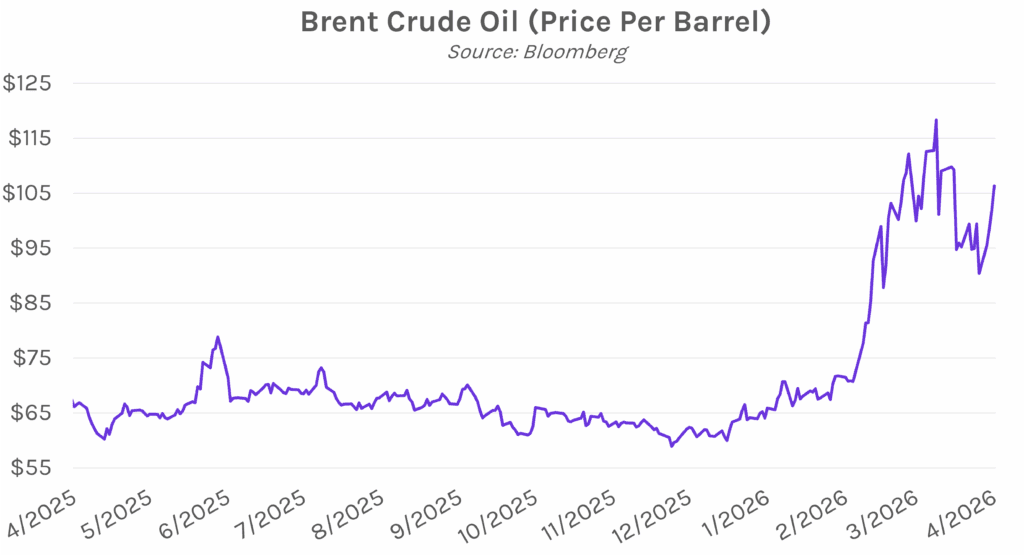
US-Iran war fuels late volatility. Treasury yields soared 4-6 bps to intraday highs this afternoon on news that Iranian Parliament Speaker Ghalibaf resigned from their negotiation team and that Iranian air defense systems were triggered against “hostile targets,” which were presumed to be Israeli attacks. However, the move partially reversed after Israeli officials stated that they did not launch attacks today. The 2-year yield ultimately closed 4 bps higher at 3.83% while the 30-year yield was unchanged at 4.91%. Meanwhile, equities declined and oil rose on the geopolitical tensions. The S&P 500 and NASDAQ closed 0.41% and 0.89% lower, respectively, while Brent crude climbed over 4% to ~$106 per barrel.
US-Iran tensions rise as negotiation standstill continues. Tensions between the US and Iran continue to escalate amid paused peace talks, primarily driven by the standoff in the Strait of Hormuz. The US Navy has continued its blockade surrounding Iranian ports, with President Donald Trump posting on social media that “no ship can enter or leave without the approval of the United States Navy.” Additionally, Trump ordered the Navy to shoot any boat placing mines in the strait, amid reports that Iran’s navy was laying more mines. White House Press Secretary Karoline Leavitt said, “The point of this is the economic leverage that we maintain over Iran now… And the crux of that is this naval blockade. We are strangling their main source of revenue.” Meanwhile, Iran continues to keep the Strait of Hormuz closed, and there are reports of at least three Iranian attacks on vessels in the strait today.
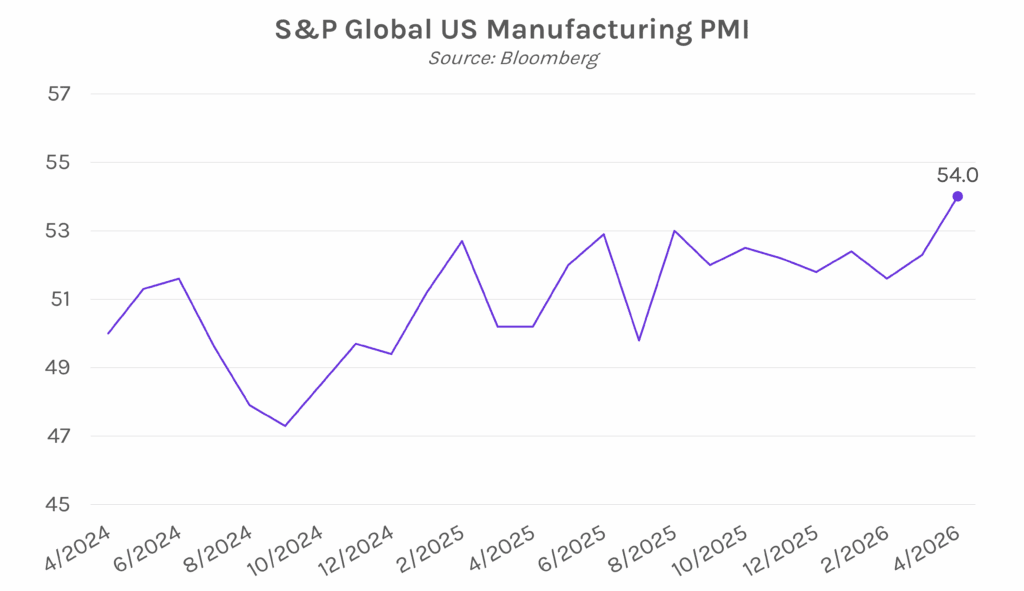
US manufacturing activity picked up alongside rising prices. Preliminary April data showed US manufacturing PMI at 54.0, the sector’s strongest growth in nearly four years and above estimates of 52.5. The composite PMI rose 1.7 points to 52.0, hitting a three-month high. Manufacturing output strengthened as new orders expanded at the fastest pace since 2022, reflecting stronger demand as the Iran war drives concerns about price increases, supply shortages, and longer delivery times. A measure of prices rose to 59.9, the highest level since July 2022, signaling that business are increasingly passing through higher materials costs to customers. Meanwhile, services PMI rebounded after falling into contraction territory in March, but remained relatively subdued at 51.3.