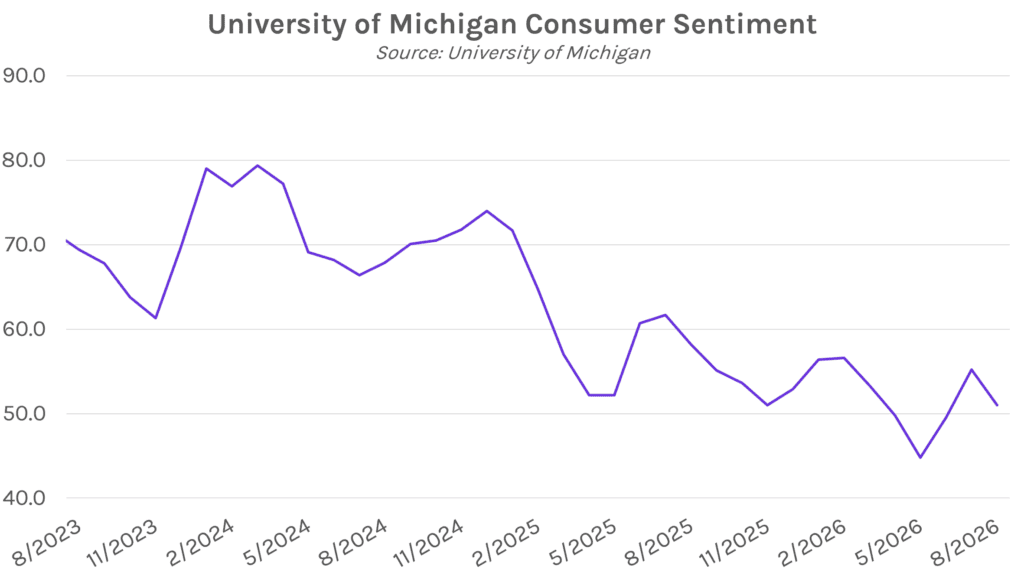
Yields rise as US prepares economic sanctions on Iran. Treasury yields ended the day higher after US Treasury Secretary Scott Bessent said the US would soon impose economic measures against Iran that “have never been seen in the history of economic isolation on a country.” The 2-year yield closed 3 bps higher at 4.17% (down 3 bps on the week), while the 10-year yield closed 5 bps higher at 4.69% (up 4 bps on the week). Equities fell on weak retail sales and consumer sentiment data, with the S&P 500 and NASDAQ closing 0.17% and 0.28% lower, respectively.
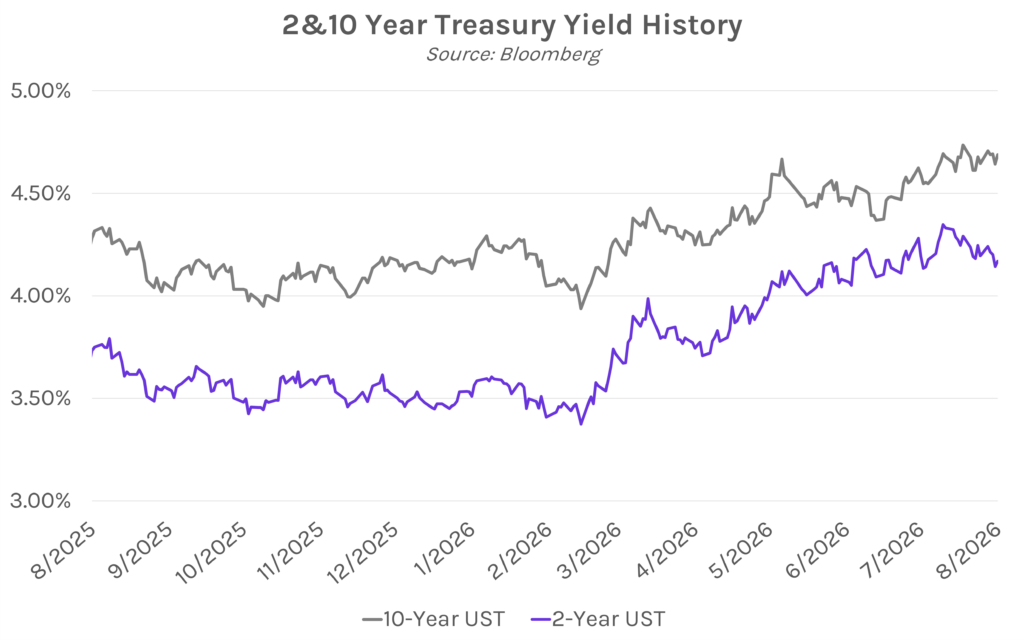
Retail sales post largest drop in over a year. Retail sales in July fell 0.6% from a month prior, the most in over a year, largely driven by a pullback in online sales and auto dealer sales, which decreased by 2.2% and 1.8%, respectively. Excluding automobiles and gas, retail sales fell 0.2%. Spending at restaurants and bars climbed 0.5%. Stephen Brown, chief North America economist at Capital Economics, attributed the weakness to timing rather than a broader slowdown, noting that “the miss in July was mainly due to a sharp fall in non-store sales which likely reflects the different timing of Amazon Prime Day this year, rather than a fundamental downshift in consumer spending growth.” Amazon Prime Day was moved from July to June this year.
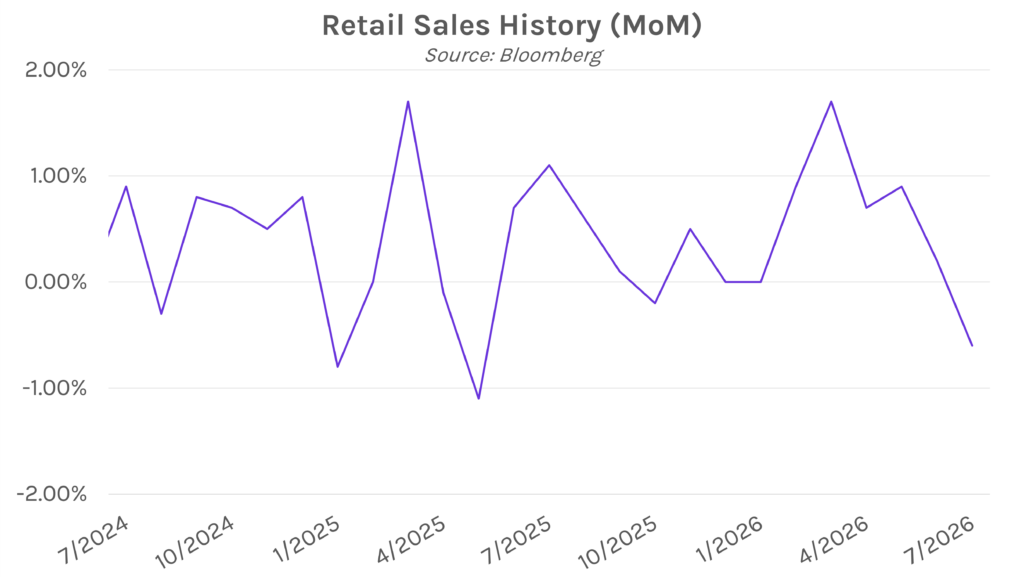
Consumer sentiment drops for first time in three months. The University of Michigan Consumer Sentiment Index came in at 51.0 for August, down from 55.2 in the prior period and below forecasts of 55.0. Short-term inflation expectations rose slightly from July, with respondents expecting prices to increase 4.3% over the next year. Long-term inflation expectations were unchanged at a 3.3% annualized rate over the next five to ten years. Notably, consumers are increasingly worried about inflationary pressures and less so about the labor market. Joanne Hsu, the director of the survey, noted that weakened sentiment was felt across all demographics, though particularly among “older consumers, lower-income consumers and those without a college degree,” who are “all particularly vulnerable to any erosion of purchasing power stemming from inflation.”