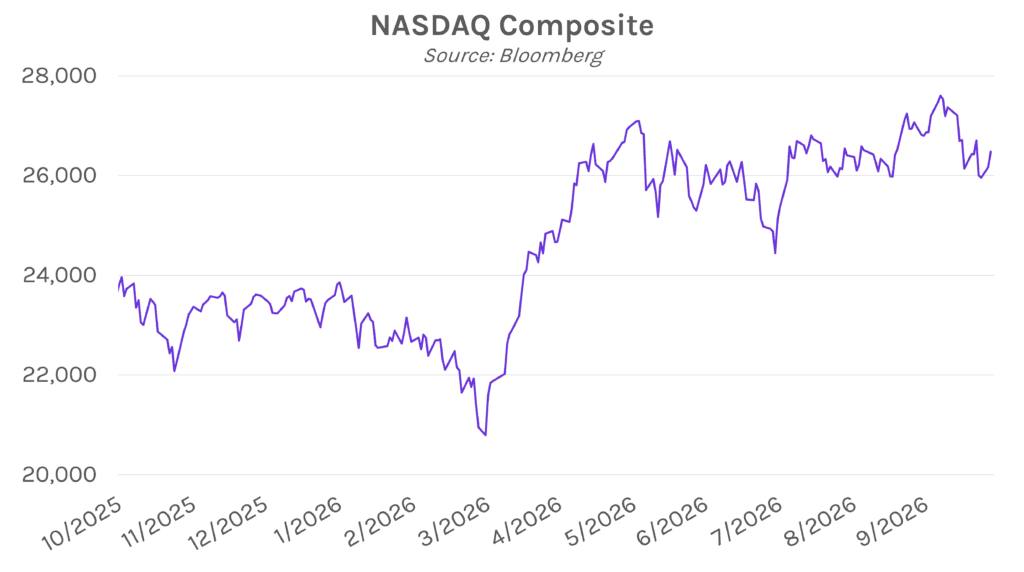
Yields rise as markets shift risk-on. Treasury yields edged higher today as risk appetite improved, with artificial intelligence and technology stocks rallying. The 2-year yield closed 2 bps higher at 4.74%, while the 10-year yield closed 1bp higher at 5.00%. Market focus now turns to tomorrow’s FOMC decision and Fed Chair Warsh’s press conference for any hints on the December meeting. Meanwhile, the S&P 500 and NASDAQ closed 0.60% and 1.18% higher, respectively, heading into this week’s earnings results from Alphabet Inc., Microsoft Corp., and Amazon.com, Inc.
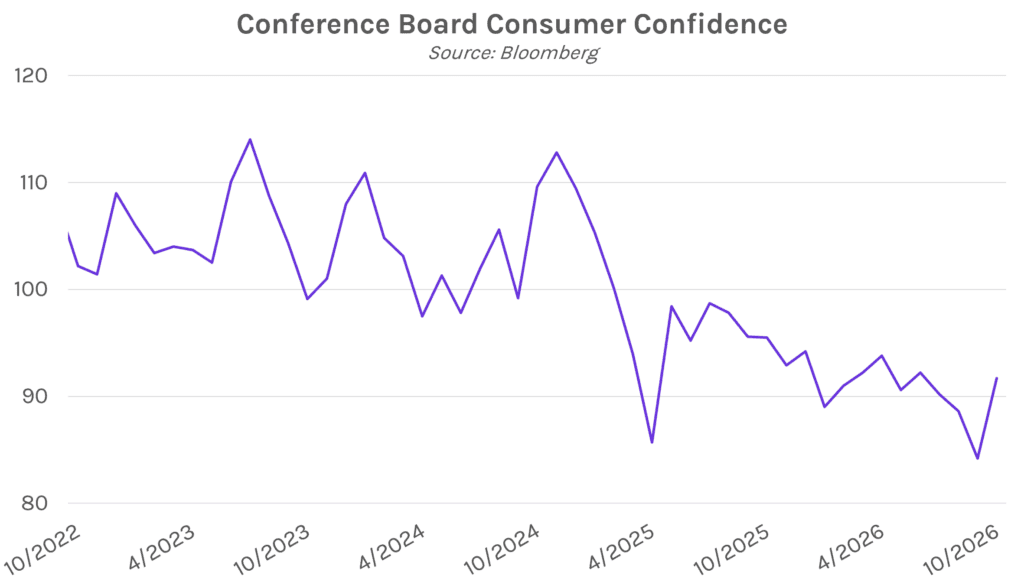
Consumer confidence climbs to highest level since June. The Conference Board consumer confidence index rose 7.5 points to 91.7 in October, well above expectations of 81.0 and the prior period’s upwardly revised 84.2. Fergus McCormick, senior economist for global indicators at the Conference Board, attributed the rebound to “retail gasoline prices easing from September to October,” as gas averaged $4.26 per gallon over the past month, down 4.7% from the prior period but up 28% YoY. McCormick also cautioned that, despite the uptick, “consumer confidence remains on the long-term downward trend that has persisted over the past few years.” The survey also showed that consumers plan to spend less on services and durable goods over the next six months, as inflation concerns linger.
Capital goods orders hit five-month high. US durable goods orders rose 1.8% MoM in September, just below forecasts of 1.9% but well above the prior period’s 0.1% increase. Aircraft bookings drove much of the gain, rising 28.4% on the month, alongside other business equipment such as computers and machinery, as US manufacturing activity remains solid. Core capital goods orders, which exclude volatile aircraft and military hardware orders and are considered a proxy for general equipment investment, rose 0.5% last month, down from 1.6% in the prior period. Priscilla Thiagamoorthy, senior economist at BMO Capital Markets, said the report showed that “underlying demand continued to expand” beyond aircraft orders, adding that “firmer capital goods shipments suggest equipment spending helped support economic growth at the end of Q3 with plenty of momentum heading into Q4.”