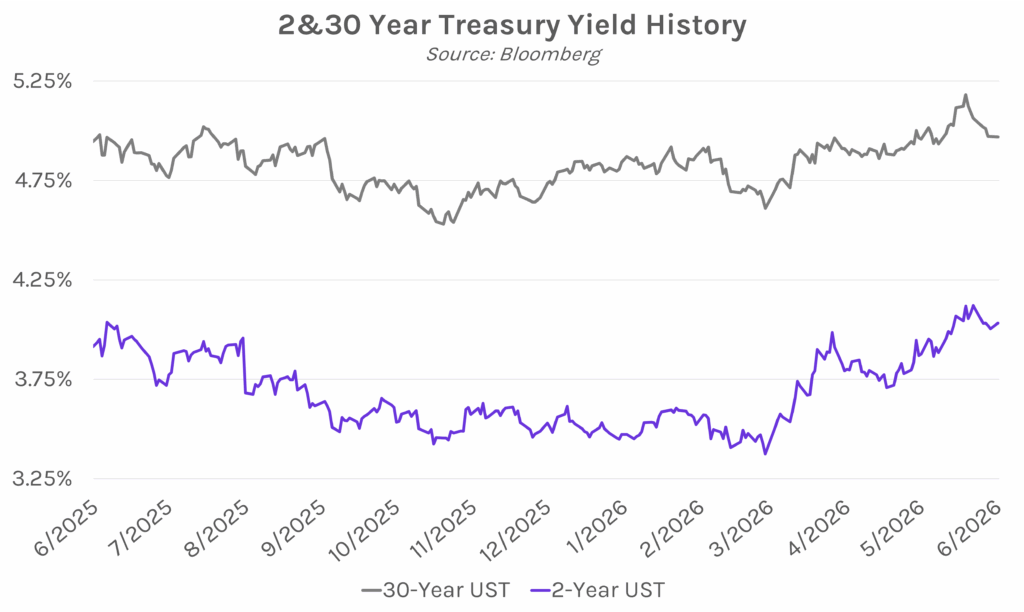
Yields little changed despite US-Iran peace talk standoff. Treasury yields rose 6 bps this morning as news emerged that Iran was halting negotiations with the US, though the move largely reversed in the afternoon as Trump said talks were ongoing. The 2-year yield ultimately closed 3 bps higher at 4.03%, while the 30-year yield closed nearly flat at 4.97%. Meanwhile, equities continued to rally, with the S&P 500 closing higher for the eighth consecutive session at 7,600. WTI crude rose 5.50% to close at $92.16 per barrel as escalating tensions near the Strait of Hormuz revived supply concerns.
US-Iran tensions flare as Tehran suspends peace talks. Iranian media reported today that its “negotiating team will suspend ‘talks and the exchange of texts through mediators'” with the US, in response to Israel’s expanding military offensive in Lebanon. Separately, Iran’s Foreign Affairs Ministry said the US “bears direct responsibility for both the violations of the ceasefire against Iran and for the violations committed…against Lebanon.” Meanwhile, President Trump contradicted Tehran on social media, stating, “talks are continuing, at a rapid pace,” and adding that Iran “really wants to make a deal.” Trump also said he asked Israeli Prime Minister Benjamin Netanyahu not to send more troops into Beirut and that Netanyahu agreed.
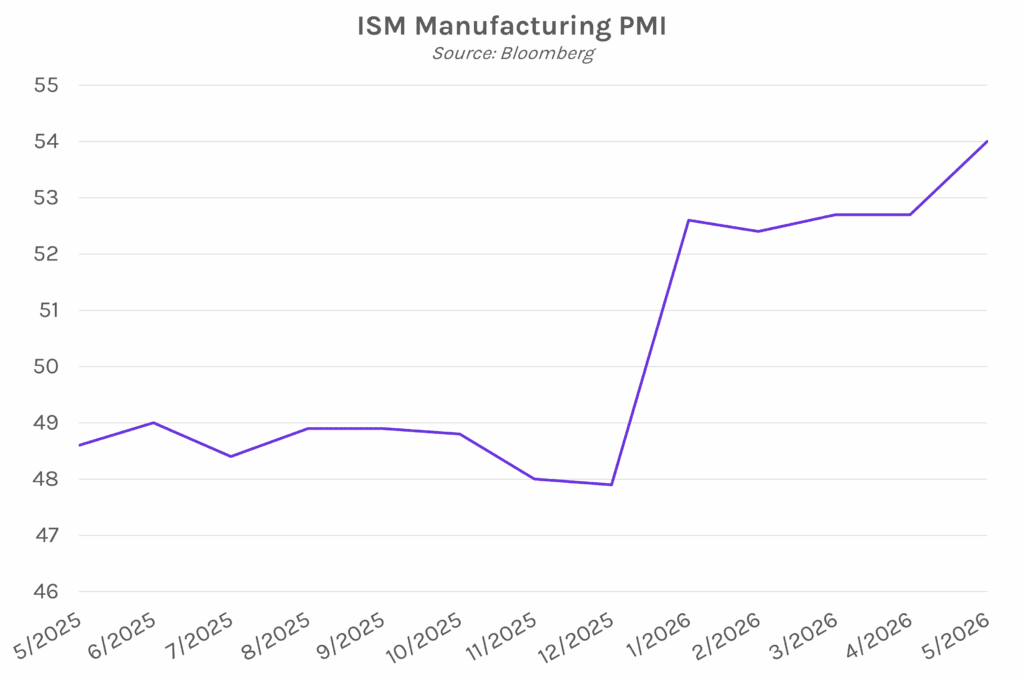
Manufacturing activity sees most growth in four years. The ISM manufacturing index rose to 54.0 in May, topping estimates of 53.0 and April’s 52.7 reading. May marked the fastest pace of expansion in four yearsand was driven by an uptick in new orders and production. Almost every manufacturing industry saw growth, from printing to electrical equipment, with only wood production experiencing contraction. ISM manufacturing has increased for five consecutive months, driven by soaring artificial intelligence investment and subsiding trade policy uncertainty. Susan Spence, chair of the ISM Manufacturing Business Survey Committee, attributed the growth to pent-up demand rather than companies looking to expand their inventories.